
Safe Buddhism
The Death of Western Buddhism: Part 10

This is the final online installment of my book Lost in Transmission. The printed version of this work will contain two or possibly three extra chapters. In the next few months, my online output will reduce down to one or two newsletters per month, while I bring together and digitize my notes from the last few decades and attempt to conjure up a new, but related direction in my writing.
The Dharma Feast
Let’s begin with a familiar scene:
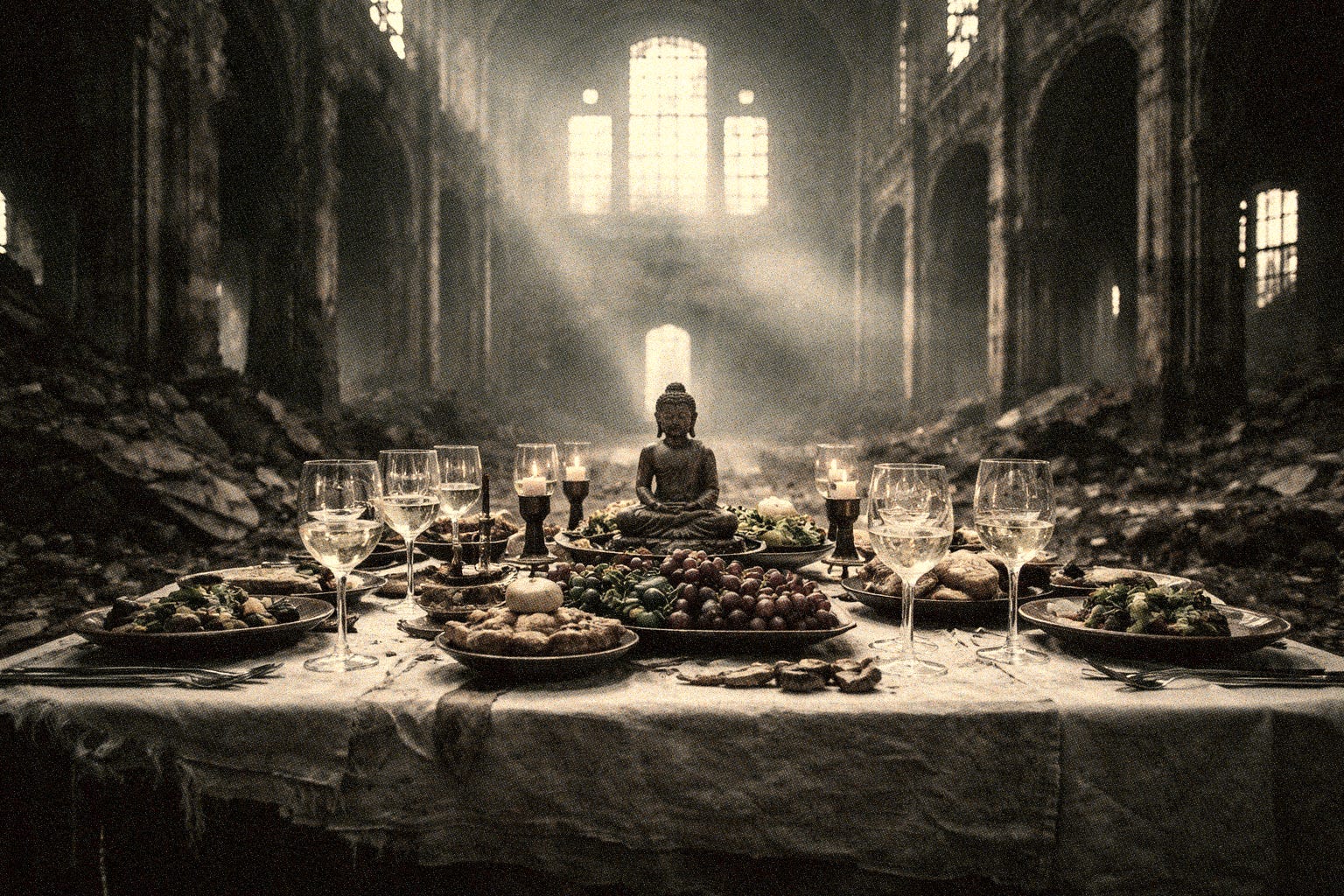
It’s a dinner party. The lighting is low and expensive, the wine is organic, and the conversation has drifted, as it inevitably does nowadays, toward the management of stress. Someone, usually a man who works in software or a middle-aged woman wearing sustainable linen, leans across the reclaimed wooden table to deliver a proclamation. They lower their voice, adding a conspiratorial gravity to the confession.
“I’m not religious, obviously. But I’ve been getting into Buddhism. It’s basically just a science of the mind, you know? It’s amazingly rational. No gods, no magic. Just… psychology.”
They speak with the earnest confidence of a recent convert, explaining that Buddhism is essentially a 2,500-year-old stress reduction technique that happened to be invented by a prince in iron-age India, rather than a tenured professor at Stanford. Of course, it is entirely rational to want a Buddhism that pairs with our informed worldview. In a world of fake news and collapsing institutions, we are desperate for something that feels as verifiable and solid as the smartphone in our pocket — even if that solidity is ultimately a trap.
The faces around the table nod in collective agreement. The tension dissipates. No one has to confront those wrathful protector deities drinking blood from skull cups; or those cave yogis offering their flesh to local spirits; or even those nuns spending their lives in dark retreat and then disappearing into rainbow bodies of light. And even better still, there’s no need to worry about the hell realms...we have X for that. Since no one even raised an eyelid, we can all just seamlessly glide back to the risotto served up on the tasteful, beige, ceramic tableware.
The Buddha briefly came to dinner but was fully vetted and frisked by security before he got through the doors. He was stripped of his golden skin, his superpowers, and his incredible claim to have conquered death itself. He was reduced to a very chilled, very reasonable life coach who wants you to breathe deeply through your nose when your emails pile up. This is the safe Buddha. This is the Buddha who can be discussed in polite society without anyone having to admit they believe in any of that woo-woo.
The Hyperreal
But there is a problem with this dinner party facade. It is a lie. This comfortable, sanitized Buddhism is a well-marketed, thoroughly modern lie, but it is a lie nonetheless. It is a textbook example of what Baudrillard called a simulacrum — not simply a copy of the original, but something far more insidious: a copy so polished, so perfectly calibrated to our existing preferences, that it eventually replaces the original in our cultural memory.1 We no longer know what was lost, because the replacement arrived pre-loaded with a veneer of authenticity. This is what Baudrillard called hyperreality: a novel map that replaces the territory. We see it in the ten-minute guided audio that feels more spiritually nourishing than the discipline of gruelling retreat time. We encounter it in the wellness app that feels more like real Buddhism than the monastery with the cold floors, the 4am wake-up bell, and that annoying teacher who keeps pointing at things you would rather not look at. The simulation is not recognised as a simulation; it is experienced as the real thing.

According to the late Nyingma master Thinley Norbu Rinpoche, this is arguably the single most destructive force in the spiritual landscape of the West.2 We have taken a tradition designed to shatter the very fabric of reality “a vajra-hammer meant to pulverize the dualistic ego” and we have turned it into a coping mechanism for the very materialism it was meant to destroy. We have traded the dazzling, electric, alive cosmology of Mahayana Buddhism for a sterile universe where consciousness is just a brief flicker in a biological machine.
Thinley Norbu didn’t call this secularism. He didn’t call it modernization. He called it the nihilist habit.3 Now, we must handle this word nihilist with surgical precision. In the Western imagination, nihilism conveys the weary sigh of the existentialist who believes in nothing. In Norbu’s reading of the Dharma (one of many), nihilism is the active dogma of the materialist who believes first and foremost in the physical world. His nihilism doesn’t boil down to the gloomy vibe and fashion sense of a teenager reading Nietzsche in a coffee shop; it cuts much deeper. It is a metaphysical amputation. It is the view that the person is nothing more than the physical body. It is that specific, fatal error of reducing the vast, luminous mind down to a byproduct of brain chemistry.
The Nihilist Habit
To diagnose this disease, we have to dissect the host. The Dharma did not arrive in the West into a philosophical vacuum; it arrived into a worldview that had already, quietly, made up its mind about the nature of reality.
The contemporary Western worldview runs on a single, unshakable dogma, one so deeply embedded we no longer recognise it as a dogma at all. It’s just reality. Just science. And that dogma is this: matter is primary. In this view, the universe is composed of unconscious matter — a vast, cold, mechanical expanse of gas and rock where, through some statistically improbable accident of chemistry, a few carbon-based structures started thinking. We are told that the brain creates the mind. When the neurons fire, we feel love. When the neurons stop, we rot. Consciousness is a biological flicker, a momentary haunting of a meat computer that will eventually crash and be discarded. The whole show last maybe eighty years. Then nothing.
This is our default firmware. Installed for almost everyone educated in post-enlightenment modernity. You might hope for something else. You might read horoscopes or buy crystals or secretly whisper a prayer when you hit turbulence at 35,000 feet. But when the existential crunch arrives, the operating system reasserts itself. You are meat. You are neurons. You are a brief, self-aware biological event. A temporary epiphenomena of the brain. Norbu identified this not merely as a scientific opinion, but as a “pessimistic habit”.4 It is pessimistic not because it makes you gloomy — though the realization that your existence is meaningless should probably ruin your afternoon — but because it a spiritual guarantee of nothing. It is a dead end. If you believe that you are merely the body, then ultimately, nothing matters. Your compassion, your insight, your moments of transcendent clarity are just chemical misfires that will vanish the moment your heart stops beating.
Traditional Buddhism, specifically the Vajrayana lineages that Norbu represented, operate in a completely different universe. In the Buddhist view, mind is primary. The world is continuous and alive. Matter is just the play of energy and emptiness, a projection of the mind rather than its source. The clash happens when we try to drag the Dharma into the nihilist universe. We say we like the meditation part, but we want to cut out the reincarnation part because it sounds like a fairy tale. We think we are being rational. We think we are pruning the dead wood of superstition to reveal the healthy core of truth. But Norbu argues that we are actually performing a lobotomy. By filtering Buddhism through a materialist lens, we strip it of its power to liberate. We turn it into a palliative care program for a life that we believe is ultimately terminal.
The tragedy is ironic. We run to Buddhism to escape the existential dread of our materialist worldview. The fear of the void, the fear of nothingness, the fear of erasure and death. But then we reshape Buddhism to fit that same materialist worldview. We create a spirituality that promises us the exact nothingness we are running from, only now we label it “equanimity” instead of “annihilation.”
Buddhist Modernism Inc.
Historians like David McMahan call this “Buddhist Modernism” — a specific, hybrid creature born from the collision of Asian reform movements and Western existential anxiety, each side wanting something the other had.5 The Asians wanted legitimacy in a colonial world that equated rationality with civilisation. The Westerners wanted transcendence without the metaphysical overhead. Both sides made the deal. Both sides shook hands across the table. The resulting product was clean, scalable, and thoroughly rationalised. Buddhist scholar Alexander Berzin called it Dharma Lite: a stripped down version of Buddhism where we keep all the mindfulness, add a drop of meditation, but trim off all the cosmology, rebirth, and karma, to create a bespoke product tailored for the modern subject.6 A product that morphed in the blink of an eye into a monthly digital subscription with an optional premium tier.
The architects of this rebranding, those early Western teachers who wanted to make the Dharma safe for a post-Christian, scientifically literate audience made a calculated trade. They stood before the sprawling, maximalist, gloriously strange edifice of traditional Buddhism — with its skull cups, past lives, wrathful deities, and troublesome rituals — and asked themselves a single question. What can we sell to a culture that only believes in atoms?
The answer was: The Psychology.
There is no need to hunt for a smoking gun to locate this gutting of the Dharma; the evidence is filed openly in the “Best Sellers” section of every spiritual bookstore in the West. Following their first contact with the Dharma, many Western teachers returned to the comfort of their homelands and pivoted. There wasn’t any great conspiracy behind this; it was a rebranding campaign that simply worked and spread. Buddhism was no longer a religion of salvation across lifetimes; it was condensed down to a psychology of this life.
We didn’t need a secretive cabal scheming behind the scenes to strip Buddhism of its metaphysics; we did it openly, with pride. Books like Stephen Batchelor’s Buddhism Without Beliefs didn’t just suggest we could drop rebirth; they argued that we must drop it to save the Dharma from “cultural accretion”.7 Rebirth was Indian excess baggage. Karma was iron-age morality. If we scrub all that off, we reveal the “core” — which, conveniently, looks remarkably like cognitive behavioral therapy, but with incense.
Batchelor’s prose was elegant and his logic soothed the modern ear. And I must admit, I was initially seduced by his arguments. He sounded so… so… rational. Maybe he would successfully remold Buddhism into a ideal western form, I asked myself. I mean, even that stalwart of secular thought, Christopher Hitchens of all people, raved about his book. And this appeal to rationality is exactly why his re-framing was dangerous.
And here we should pause for a moment and be honest about Bachelor’s work. Because the steelman of his position is worth taking seriously before we dismantle it. His argument was never simply “Buddhism is CBT with incense.” It was more sophisticated than that, and more dangerous precisely because of it. Batchelor cited the Cūḷamālukyasutta8 one of the oldest Pāli sutras, where the Buddha himself consistently refuses to speculate on metaphysical questions.9 Rebirth, the soul, the nature of the cosmos after death: the Buddha declines them all. Not because the answers don’t matter, but because clinging to any view, including the view of rebirth, is itself a form of ignorance, grasping to which perpetuates suffering. From this reading, the secular Buddhist is not betraying the Dharma. They are performing a more rigorous version of it — refusing the comfort of metaphysical certainty in all directions, including the Buddhist direction. It sounds brave. It sounds honest. For a moment, it even sounds rather enlightened.
But here is the sleight of hand. There is a categorical difference between suspending metaphysical speculation as a meditative discipline — holding all views lightly, living in the spaciousness of genuine not-knowing — and replacing that suspension with a materialist ontology as the unexamined default. The Buddha’s silence on rebirth was not a vote for neurons. It was a silence: spacious, alive, pregnant with the very mystery that makes practice possible. The secular Buddhist does not inhabit that silence. They fill it, reflexively and immediately, with the Western factory firmware: matter is primary, consciousness is biological, death is termination. That is not the Buddha’s refusal of all views. That is just the nihilist habit wearing an exotic robe. That brand of skepticism is not neutral. It is a full metaphysical commitment. One that arrives preinstalled, is often mistaken for common sense, and only rarely gets questioned.
This was a fundamental redefinition of the project of Buddhism. It shifted the goal from soteriology (saving beings from the infinite cycle of suffering) to therapeutics (helping beings cope with the stress of modern life). Norbu calls this tendency a deviation. When we treat Buddhism as just a philosophy or a science, we are trying to make it “safe” for the dualistic mind. We are trying to squeeze the ocean into a coffee mug.
By refusing to engage with the intangible or magical aspects of the Dharma, the parts that defy materialist logic, we cut ourselves off from the actual juice of practice. Yes, we might get a little bit calmer. We might become slightly better listeners. We might even lower our blood pressure. But we never touch the radical, reality-altering freedom that the Buddha actually promised. We are reaching for the painkillers when the doctor is offering a full cure.
The Emptiness Upgrade
The most dangerous casualty of this great flattening is the concept of emptiness, or Śūnyatā. In the hands of a materialist, emptiness is terrifying. It sounds like a void. It sounds like the burn-up of the universe. When a nihilist hears that the nature of reality is emptiness, they hear that nothing exists. They hear that their life has no meaning, that their loves and griefs are illusions, and that the ultimate truth is a blank static state of non-existence. This interpretation leads inevitably to a cool, detached irony, a spiritual withdrawal where we care about nothing because it is all just an illusion anyway.
Norbu attacks this view with ferocious precision, using the analogy of the sky to correct the error.10 Imagine the sky. It is empty. It has no substance. You cannot grab a chunk of blue and put it in your pocket. But precisely because it is empty, it allows everything else to exist. Clouds can form, birds can fly, the sun can shine, and the wind can blow. If the sky were solid, if it were not empty, nothing could move. Existence would be like a frozen block of concrete.
True emptiness is not a lack of something; it is the capacity for everything. It is the substanceless origin, the fertile, pregnant ground from which all phenomena arise. The shift in perspective is subtle but total. The nihilist sees emptiness as a black hole where things disappear. The Buddhist sees emptiness as the womb where things are born, the Tathāgatagarbha. When we view emptiness through the nihilist lens, we become zombies. We use detachment as an excuse to disengage from the world. But true realization of emptiness leads to more engagement, more compassion, because you see the play of energy as miraculous, unfettered, and alive.
Insecure about our spirituality, we turn for validation to our new god: science. We point to fMRI scans of monks and say, “Look! His prefrontal cortex is lighting up! It’s real!” We quote Heisenberg and Schrödinger and say, “Look! Quantum mechanics says reality is weird, just like the Sutras said!” But Norbu argues that this seeking validation is a form of cultural imperialism that actually degrades the Dharma. When we demand fMRI evidence for meditation, we are implicitly saying that the Western scientific method is the ultimate arbiter of truth, and Asian wisdom is merely a “defendant” that must prove its innocence.
Norbu compares it to a man seeing a mirage and deciding to build a dam. The meditator stays still, enjoying the empty clarity of the vision. The scientist, however, driven by the need for solid proof, chases the shimmering water of the mirage, measuring heat and light, convinced that appearance implies substance. But the mirage has no wetness to give. The more they analyze the appearance, the further they drift from the truth, until they are left gasping for breath with a mouthful of sand.
The qualities of enlightenment — wisdom, awareness, non-dual compassion — are not material. They cannot be measured by a machine that detects electromagnetic fluctuations. You cannot put bodhicitta in a test tube. You cannot measure the merit of a prostration with a Geiger counter. When we insist that Buddhism must align with current scientific consensus, we are submitting to the limited reasoning of the dualistic mind. We are saying that matter is the judge of spirit. If science says rebirth is impossible, the modern Buddhist says, “Okay, we will drop rebirth.” Norbu asks: Who is the master here? By seeking validation from a materialist system, we forfeit the sovereignty of the spiritual view. We make the mistake of thinking that because the map of science does not show the territory of enlightenment, the territory must not exist.
The consequences of this spiritual surgery are severe. We are left with a practice that is dry, reduced to a form of mental calisthenics that exercises the prefrontal cortex but leaves the heart untouched. Without the magic — such as belief in lineage blessings, non-visible beings, and the continuity of mind — meditation becomes a chore, a gym workout for the brain. It is brittle and ultimately boring.
More tragically, there is no true transformation. Norbu warns that if you treat the teachings as mere philosophy, you miss the inconceivable qualities.11 You might become a great scholar. You might be able to debate the finer points of Madhyamaka logic and impress the dinner party guests with your knowledge of Sanskrit terms. But you will not change. Your ego remains exactly as solid as it was before, only now it is wearing a spiritual costume. It has learned to hide behind the rhetoric of emptiness, but it is as neurotic and fragile as ever.
And so, the anxiety returns. Because we have not uprooted the fundamental fear of annihilation — the belief that we are just meat — our anxiety never truly leaves. We meditate to calm down, but the background hum of “I am going to die and cease to exist” is always there, vibrating just beneath the surface of our mindfulness. The nihilist habit ensures that our deepest dualistic fear remains untouched, protected by the very skepticism we cherish as our intellectual armor.
So Now What?
The remedy Norbu offers is not comfortable, because it requires us to wound the one thing our culture has crowned as the mark of intelligence: our skepticism. We have to admit, unabashedly with clear eyes, that our reflex to disbelieve is not the result of careful inquiry. It is a cultural inheritance. It arrived pre-installed, factory-sealed, mistaken for common sense before we were old enough to question it. The skepticism is not neutral. It conceals a full metaphysical commitment to the belief that consciousness is biological and terminates at death. If we pause for a moment to be intellectually honest we can see that this is not truly rational. It is a closed system, running on a disk that was never formatted.
The first step, then, is to stop mistaking this western worldview for reality, and to start recognising it for what it actually is — a view. Not the view. A view. It is one possible account of an enormously complex situation, held by humans who evolved to hunt and forage on the savannah and have, only very recently, started trying to understand the nature of mind. That is the intellectual humility the tradition demands. Not faith. Not devotion. Not the surrender of critical thinking. Just the simple acknowledgment that we do not actually know what consciousness is, that the materialist account has not solved the hard problem and shows no signs of doing so, and that in the space between what science measures and what it does not, an entire living tradition of inquiry has been quietly practicing for two and a half millennia. Suspend all disbelief. Not permanently. Not uncritically. Just enough to see what is on the other side of the door you have been leaning against. We have to play with the possibility that the mind is not the brain. That the empty luminous mind is primary, not a byproduct of brain chemistry. We have to respect that mystery and stop trying to sanitize the Dharma to make it safe. Let it be weird. Let it be challenging. Let it offend our rational, over-educated sensibilities. That friction, that offense, is where the growth happens. That is where the shell of the ego begins to crack.
The West wanted a Buddhism that was safe. They wanted a Buddhism that fitted neatly into their Google Calendar and didn’t make them look crazy at dinner parties. But a safe Buddhism is a dead Buddhism. In contrast, Thinley Norbu described what he calls the “White Sail”, a vehicle to cross the ocean of suffering. But to get on that vessel, we have to leave the solid ground of scientism behind.

And if you alight, you might still sit at that same dinner table, amidst the clinking of glasses and the dry talk of dopamine hits, but you will no longer be one of them. You will sip your wine with a secret smile, knowing that while they are discussing the map, you have already set sail into new territory — a vast, empty, electric reality that their science cannot measure and their politeness cannot contain.
The choice is ours. We can keep our rational, safe, Nihilist Buddhism as a pacifier for the dying ego. Or we can drop that pessimistic habit, open our eyes, and actually wake up. The void may be calling. But so is the sky.
Simulacra and Simulation, Jean Baudrillard, (1994, University of Michigan Press).
See Norbu, Thinley, Magic Dance (1999, Shambhala Publications), & Norbu, Thinley, White Sail, (2012, Shambhala Publications).
Norbu, Thinley, White Sail, p. 11.
Norbu, Thinley, White Sail, p. 15.
See The Making of Buddhist Modernism, David L. McMahan (2008, Oxford University Press).
See Buddhism Without Beliefs, Stephen Bachelor, (1998, Bloomsbury publishing).
Cūḷamālukyasutta (MN 63) see https://suttacentral.net/mn63/en/sujato
Stephen Bachelor, Buddhism Without Beliefs, p.14-15
Norbu, Thinley, White Sail, p. 38
Norbu, Thinley, White Sail, p. 46
I've only recently discovered your blog and have been reading this series with great interest. But I skipped ahead to read this chapter this morning and I'm glad I did. It's like a drink of clear cold water for me. You address many things that trouble me deeply about the "Buddhism isn't religion it's psychology" stance that it so common. I feel the point about cultural colonialism is very important too.
Clumsy fingers again! I meant to add that i was surprised by your circling back to a metaphysical perspective which sits comfortably within esoteric Buddhism. I hope this isn’t the final chapter as it felt a bit like an anti-climax after your earlier laser like analysis and excoriation of some of the Teachers who have at times seduced us.