
The Crazy Wisdom Dharma Circus
The Death of Western Buddhism: Part 2

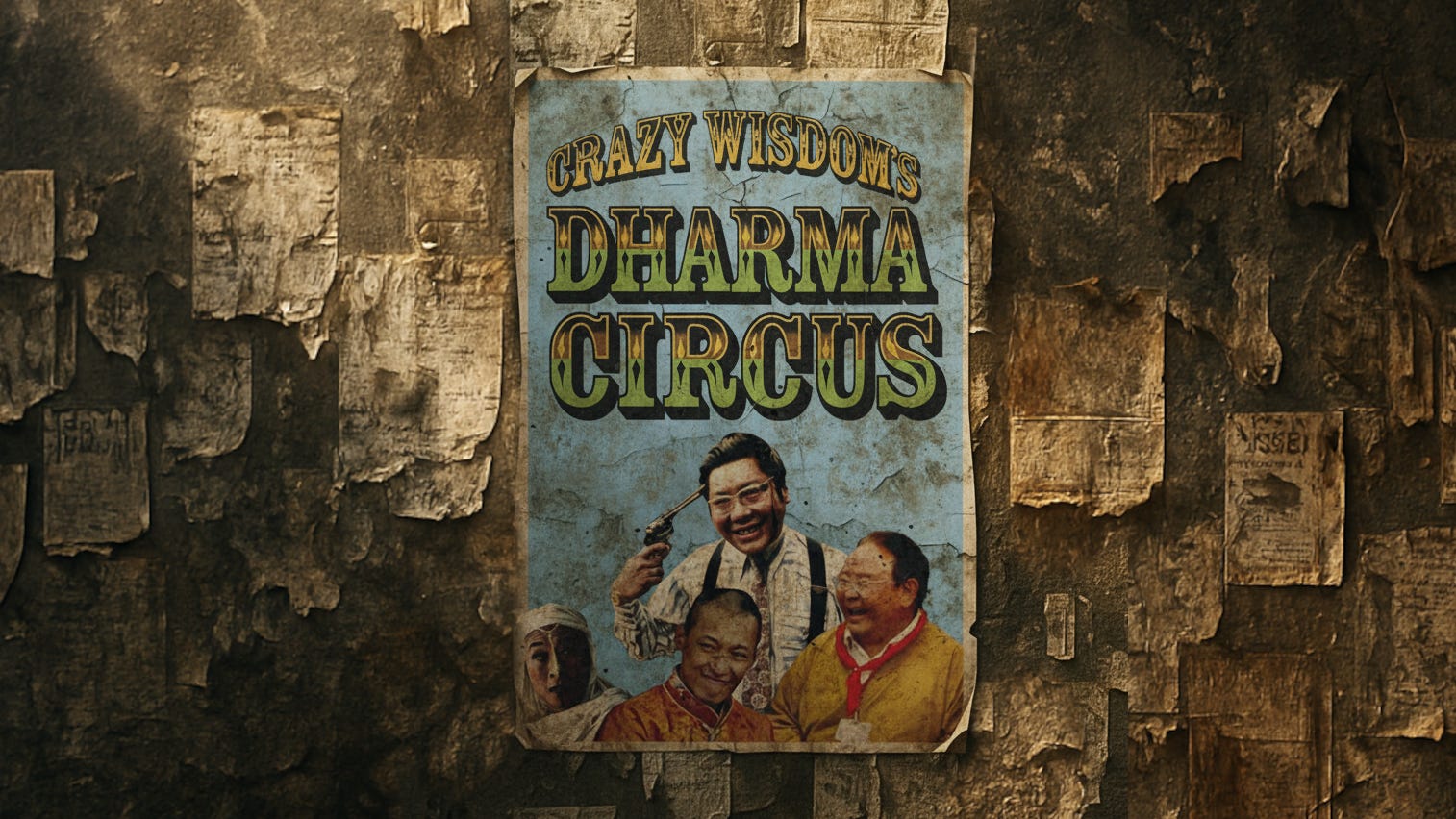
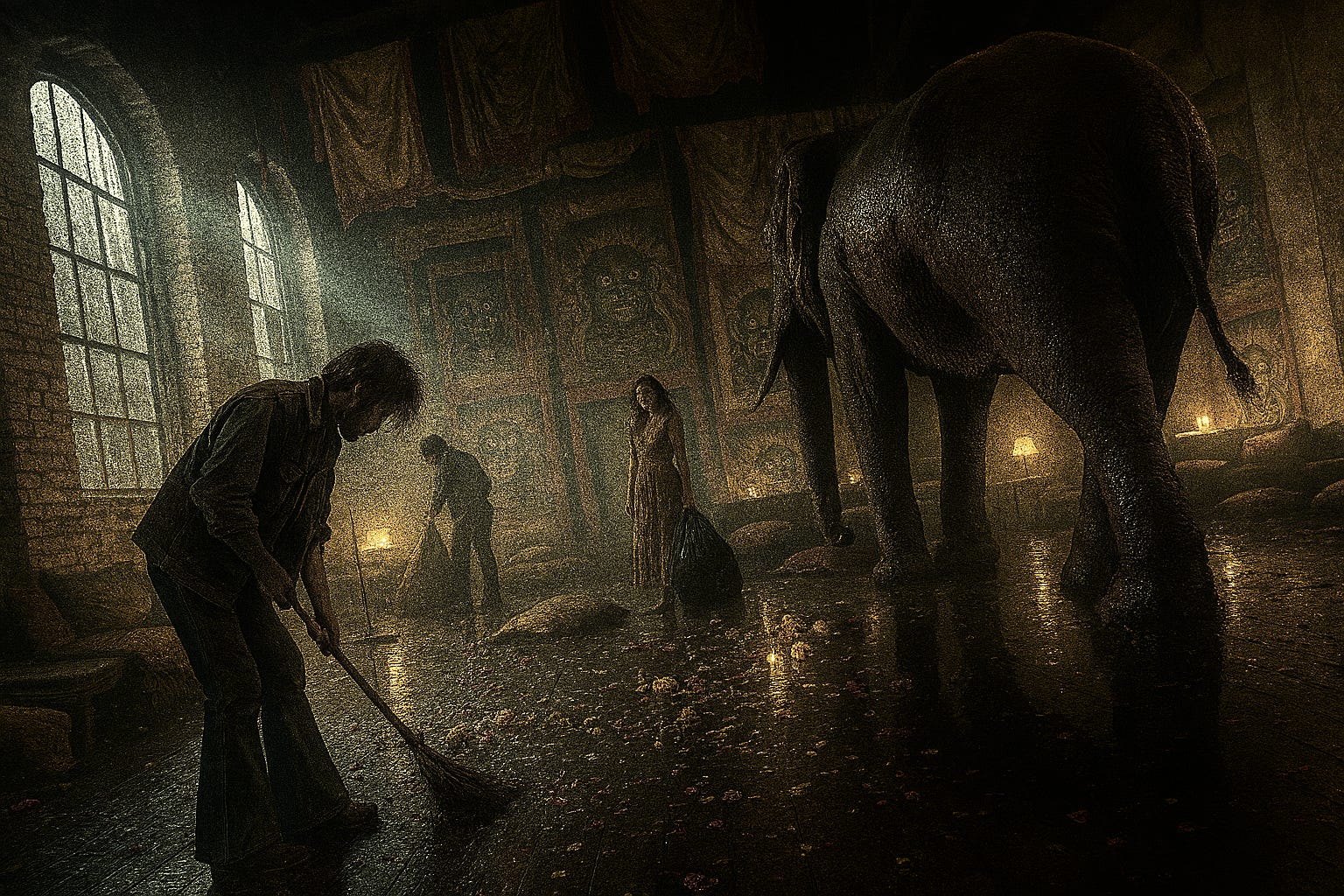
You know the feeling. The party is over. It’s the morning after. There’s a huge mess, and only a few stragglers remain to help clean up, to get things back to “normal”. There is a tacit sense of embarrassment in the air as those present go about clearing away the evidence of the previous night’s antics. People aren’t saying much, in fact the silence in the room is pronounced, and when any eye contact is made, people quickly glance away.
The room is decorated with colorful silk brocades, and images of fierce deities are positioned prominently on the walls. A lone stick of musty, earthy incense burns in the corner of the room, but its aroma is overpowered by a more prominent smell—one you can’t quite put your finger on.
You may have also caught a whiff of it, perhaps you didn't directly find the source of that putrid smell, but you noticed it, sure enough. And you wouldn’t be mistaken. If truth be told, there is an extremely large elephant occupying the spaces of Tibetan Buddhism in the West; and that elephant is covered in festering, foul excrement.
Reports and rumours have emerged that similar elephants have taken up residence in centres and temples of other Buddhist lineages in the West—but, not being intimately acquainted with those spaces, I’ll stick with the picture that has unfolded before my very eyes.
Reports from official Tibetan quarters are muted, as conservative cultural taboos demand that a great wall of silence remain erected around this elephant—a wall that ironically keeps the elephant safe and sound. Despite this silence, there is a constant reminder of its presence that hangs in the air—a foul, lingering aroma that you just can’t miss.
Those initiated into this “tantric” space are bound by a feudal code not to even mention it—or risk banishment. Banishment in traditional cultures, was a fate worse than hell, so bad in fact that they created a special hell for it called Avichi. I wouldn't want to send my worst enemy there, so, let’s guard this story closely, best we call it our little “secret.”
The Circus Elephant
Of course, news of rampant corruption at the heart of many Buddhist communities in the West— disturbing tales of sexual, physical, and financial misconduct—couldn't be contained within the flimsy walls of shame and silence erected around them. The geographic constraints that once enabled people to quickly cover up embarrassing events no longer stifle the reach of dissenting voices. News now travels at the speed of light. You only have to type the words “Buddhist Scandal” on the phone in your pocket to find evidence of this.
Even when technology renders communication nearly frictionless, speaking out is not easy, as shown by those who suffered scapegoating and exclusion from the very communities they once sought refuge in. In honour of those brave ones, I take pause for a moment of solidarity, to acknowledge their bravery and true compassion. Thank you.
The damage has well and truly been done. But to shine a light on how we arrived at this impasse, we need to take a little journey back in time to revisit the life of an individual who has been directly implicated in this mess, the one-and-only Chögyam Trungpa Rinpoche. I request you show a little patience as I take you on this journey, and please forgive me for a few creative flourishes to render this story a little less tedious for us all.
A Dream Start
Chögyam Trungpa was introduced to a general western audience through his book Born in Tibet1 published in 1966. The book recounts his early life and eventual escape from Tibet under Chinese occupation. The story he paints plays a key part in the formation of the mythology he was fond of propagating throughout his life:
“The night of my conception my mother had a very significant dream that a being had entered her body with a flash of light; that year flowers bloomed in the neighbourhood although it was still winter, to the surprise of the inhabitants.” 2
Well, that's certainly one way of describing the moment of conception—and with this poetic opening Trungpa’s incredible life story began. Following his birth he described how a succession of wise men arrived in his parent’s village and singled him out for special attention. This culminated in the arrival of a party of monks looking for the reincarnation of their recently deceased teacher, the tenth Trungpa Tulku. On finding the young boy sitting on a pile of dirt they saw a twinkle in his eyes, threw him in a bag, and quickly took him back to the monastery.
Despite being only thirteen months old, Trungpa recalled,
“I immediately recognized those monks in whom the tenth Trungpa Tulku had placed confidence, and that I behaved with the greatest decorum throughout the day and did not even cry once. A few days later I was put through a test; "Paper, Scissors, Stone!" To everyone’s amazement I won three times in a row. Now the monks were certain that I was the incarnation, so a letter was sent to Gyalwa Karmapa telling him the results of the examination and inviting him to officiate at my enthronement ceremony.”3
The great patriarch was called for enthronement and Trungpa continued:
“The service began with the rite of the primary upasaka ordination, the entrance to the Buddhist congregation. Gyalwa Karmapa cut my hair to symbolize a cutting away from the material, and entering the spiritual, life…at the moment when he put the scissors to my hair there was a clap of thunder, sudden rain, a rainbow, and a unicorn appeared. This was thought to be very auspicious”4
The extraordinary behavior did not let up, as Trungpa candidly confessed:
“My earliest memory is being in a room with several monks who were talking to me, and I was answering them. I was told later that my first words were “OM MANI PADME HUM”5
The book proceeds to detail the early life typical of many young reincarnate lamas in Tibet, who are subjected to separation from family in order to be cloistered in a monastic environment where they are moulded into teachers and dharma successors through a very intense discipline of study, ritual, and meditation under the tutelage of personal tutors and attendants. Trungpa admitted that, during his time at the monastery, his mother’s absence was clearly felt, frankly stating: “I missed her as only a small boy can.”
These tried and tested practices have historically produced a quite remarkable class of teachers who are endowed with the responsibility to receive and embody the Buddha’s teachings handed down to them from elderly masters, thereby ensuring the preservation and continued transmission of this sacred inheritance. That’s the theory, and in practice there certainly was a time when you could quite confidently take a random sample of any of these young lamas, lift them up in the air by their feet, give them a good shake, and dharma teachings would inevitably fall out.
What stands out about Trungpa’s narrative is its autobiographical nature. Trungpa paints an idealised picture of himself that he undoubtedly learned from his tutors in the monastery, a picture that sets him apart from others using standard spiritual tropes found in many religious traditions. Trungpa operates within a traditional Tibetan Buddhist discourse that legitimizes such identities as sites of epistemic authority and spiritual power. His self-narrative in Born in Tibet was not merely autobiographical but functioned as a key discursive event that produced him as a unique, authoritative spiritual subject.
Spiritual autobiography is not unknown in Tibet but is nonetheless quite rare; most biographical literature is written posthumously by students and scholar monks, following the death of great masters, functioning as branding material that highlights the purity and power of existing lineages.
What is quite unique about Trungpa’s book from a traditional perspective was how he used it as a springboard to commence his teaching journey in the West, creating a mystical set and setting that announced his arrival. All that was required was to find a receptive and willing audience—for without students there is no teacher.
What got left out
The traditional and predominately conservative picture Trungpa painted of himself in this biography conveniently failed to convey some key but significant details including a number of sexual escapades he enjoyed in and out of Tibet, one of which was a liaison he had during his escape from Chinese Communists, a story recounted many years later by his English wife, Diane Mukpo:
“On the way out of Tibet, Rinpoche had fallen in love with a young Tibetan nun, Könchok Paldrön, who was part of the escape party. He became clandestinely involved with her while he was in India. She was living in the refugee camp in Bir. She visited him at the Young Lamas Home School, and they took a mattress up on the roof of the building, where they spent the night together. She became pregnant and gave birth to Rinpoche’s eldest son, Ösel Rangdröl Mukpo, a short time before Rinpoche left for England. When she was pregnant, she made a pilgrimage to Bodhgaya, and their son was born there. She could no longer be a nun, so after Ösel was born, she worked as a road laborer to support herself for some time.”6
These things happen. Despite wilfully engaging in this diversion into romantic love, the pull was not strong enough for Trungpa to give up the robes of a celibate monk and extract his lover from the harsh reality of life breaking up stones on a roadside, a fate befallen to many Tibetan refugees at the time. It was his attachment to those monastic robes, however, that enabled him and fellow monk Akong Rinpoche to win connections and gain a grant to study in the West, in earshot of the prestigious grounds of Oxford University.
Fortunately for Trungpa, the Spalding Grant he received did not enrol him in a formal course of study with all the responsibilities that go with such a commitment, but nonetheless through a friend reading at the University, Trungpa was able to gain access to the library and other common rooms on college grounds, and it is possible that he even attended a couple of lectures. The University, however, have no records of any formal attendance.7 The small endowment the monks received to get to the UK did not go far, forcing Akong to find work as a hospital porter to pay for the small bedsit they both lived in. Whilst Akong went to work, Trungpa networked and started to gain fluency in English, quickly acquiring the affected upper-class English accent that became much loved by his future American audience.
At that time, Tibet was not only a burgeoning cause célèbre in the fight against communism, it was also highlighted by a number of fictional accounts of life in Tibet by a working-class son of an English plumber, who went under the pen name of Lobsang Rampa, and whose works were enthusiastically received in Western esoteric circles. Trungpa’s arrival in England stirred up curiosity and interest in many quarters, and he was invited to speak by a number of organisations. It was on one of these occasions that he met his future wife Diana Judith Pybus.
After reading what she described as the ‘exciting and exotic’ autobiographical work, Born in Tibet, Diana had long fantasised about meeting in the flesh the man who came alive in those pages. In her memoir Dragon Thunder she recounted her first meeting with the enigmatic Tibetan:
“I went to St. George’s Hall to attend a rally for the liberation of Tibet, and} one of the last speakers on the schedule was the author of Born in Tibet, Chögyam Trungpa Rinpoche, who appeared onstage in the maroon and saffron robes of a Tibetan monk. I looked up at him from the audience, and much to my amazement, I felt an immediate and intense connection. Before he could say anything, however, he collapsed and was carried offstage. We were told that Rinpoche had taken ill, but I imagine that alcohol may have been involved.”8
This meeting was a monumental experience for the fifteen-year-old Diana, as she stared up at the thirty-five year-old celibate monk, it was a classic case of love at first sight—later remarking:
“It was absolutely electric that first time I set eyes on him. I spent, I believe at least 24 hours in bed with him.”9
Infatuated with the young Lama, she began to use any excuse to skive off lessons at her boarding school so she could go and watch him—enthralled as only a fifteen-year-old girl could be—while he gave his signature drunken, meandering speeches. As she recalled:
“When Rinpoche first arrived in England, the Buddhist Society often invited him to teach there, and they published some of his early lectures in their journal, The Middle Way. However, at some point, the Buddhist Society and Rinpoche had a falling-out. I heard that, after they discovered he was drinking alcohol during a program, they never invited him back.” 10
As the teaching invitations dried up, in a stroke of luck Trungpa and his borther-monk Akong Rinpoche were invited to take over a Buddhist retreat centre up in Scotland that they renamed Samye Ling. Diana recalled that at first Akong didn’t mind Trungpa’s behavior—which included both sexual activity and the consumption of alcohol—as long as it was kept very private.
But any hope that Trungpa could keep things quiet was wishful thinking on the part of the more conservative Akong Rinpoche. Trungpa quickly came into repeated conflict with both him and the centre trustees as his heavy drinking and affairs with students became relentless. But the final straw came when Trungpa ran off and married Diana following her sixteenth birthday, an event that even won national press attention.
Trungpa rationalized all the fuss around his behaviour as only a misunderstood genius could. As Diana recalled,
“He didn’t feel that genuine spirituality was being practiced at Samye Ling at that point, and he thought that under the surface the whole situation was corrupt. Just before some donors arrived, while Akong was downstairs waiting to greet them, Rinpoche went into Akong’s bedroom upstairs and completely destroyed Akong’s personal shrine with his walking stick. Then he went and urinated all over the top of the stairwell, after which he lay down and passed out at the top of the stairs. He had had a lot to drink that afternoon, perhaps to work himself up to doing this. The whole event was extremely shocking, to me and everyone else there.”11
Surprisingly, this compassionate display of "crazy wisdom" didn’t resolve the differences between Akong and Trungpa, and following a crisis meeting with Diana’s Aunt and Uncle, her Uncle advised, “Well, you’d better go to America. You’ll do well in America, because anything goes there.” So they did.
Roll-up! Roll-up!
With the stuffy rooms of Oxford well behind him, Trungpa had finally resigned to the fact that the uptight reserve of the British prevented them from uncovering the genius he freely offered in his alcohol-fuelled monologues.
But things were about to change; he arrived in the United States to a very different audience, as former student Stephen Butterfield describes in his book The Double Mirror:
“Trungpa's first American students included large numbers of counterculture dropouts, refugees from the collapsing New Left, student mystics, poets, amateur yogis in rebellion against the materialism of their parents, and hippies who liked the idea of gathering in a remote rural farmhouse to grow vegetables and be weird.”12
It wasn’t only the audience that had changed; the newly married Trungpa, shifting continents for the third time, had also changed. Reinventing himself, he undertook a thorough rebranding, presenting a completely different image, as Nancy Steinbeck recalls:
“Infamously wild, in his mid-thirties, and wearing Saville Row suits, he smoked Raleighs, drank whiskey, ate red meat, and sampled the entire panoply of hippie pharmaceuticals. He’d had a son by a Tibetan nun and had run off with his blonde British wife when she was sixteen. As a holder of the exotic Crazy Wisdom lineage of Tibetan Buddhism, his outrageous behavior was traditionally viewed as teaching. His renegade flamboyance appealed to the artists, poets, and musicians who flocked around him.”13
Gone were the maroon monastic robes he had worn since childhood; gone was the pretence of a show of ascetic restraint in public; Trungpa dropped all masks and finally emerged without pretence as he really was. And in a development that may be surprising to some: the gamble paid off. He had finally found a motley crew of students gullible enough to embrace his newfound honesty.
Selling Tickets to Shangri La
The religious landscape that greeted Trungpa in the United States is like nowhere else. Following the constitutional separation of church and state in the early 1800s a unique "religious marketplace" emerged where faith communities competed for adherents without state support. In a move that truly did go against all Tibetan cultural norms, Trungpa was encouraged to take a leaf straight out of L. Ron Hubbard’s Scientology rulebook and go full corporate in his packaging of Tibetan Buddhism. How he did this is a story for another day, but, as his wife Diana reported:
“The scene during this era was a bit like our version of scenes from the reality show The Apprentice. All of these guys—and it was definitely a huge preponderance of male energy—were learning how to be spiritual corporate types under Rinpoche’s tutelage. Starting around this time, Rinpoche began to experiment with the corporate model to see if it could be adapted as the framework for organizing the Buddhist world in America.”14
All this male energy, as Diana put it, was directed into the commodification of sacred Buddhist teachings—into books, structured courses, and paid retreats. In this, and many other ways, Trungpa effectively reinvented Tibetan Buddhism for Western consumption. As Trungpa's newly crafted personal style and magnetic charisma fused with the hip, young, counter-cultural crowd that gathered around him, he created the perfect recipe for instant commercial success—the money started to flood in and Trungpa found himself realising the American Dream.
Rolling Out the Red Carpet
Despite Trungpa’s new found success Stateside, he couldn’t shake off the continued stream of rebukes his eccentric and unorthodox behavior had received from more traditional Buddhist quarters since leaving Asia. With a slick team working behind the scenes to promote and expand his brand reach, commercial success in America was assured, but that wasn’t enough—more than anything he wanted the approval of the Traditional Buddhist Teachers he had left behind in India and Tibet, approval that would legitimize his activities and turn all his dreams into a living reality. With his new-gained wealth he formulated a plan to do exactly that.
Looking around at the scantily-clad ragtag group of hippies and counter-cultural dropouts surrounding him—he knew it was going to be an uphill task. He also knew he had to keep all the partying and other excesses under wraps, but with the newly created inner-circle of corporate suits by his side, confidently exuding all their ‘male energy’, perhaps he could pull it off, it was at least worth a shot. And what he managed to achieve next was truly remarkable, in a move that probably brought many exasperated parents to tears with gratitude, quicker than Jordan Peterson could say "Clean-up your room!" he managed to transform—at least superficially—his motley group of followers from a band of long-haired flamboyant freaks into a group of suit-wearing corporate drones that wouldn't look out of place at a Mormon Sunday Service. With this impressive transformation in place, he then invited the supreme patriarch of his lineage, His Holiness the Sixteenth Gyalwa Karmapa, to come and visit.
As Diana recalled,
“Rinpoche was nervous about the visit because he knew that His Holiness had heard stories about what Rinpoche was up to, and the version he had been told had been heavy on the outrageous, wild side and light on the “working for the dharma” side. Rinpoche did not know whether His Holiness would fully appreciate what he was trying to do in America.”15
To counter this impression, Trungpa ordered his team to go into overdrive to clean up their act, he taught a crash course in Tibetan etiquette, training his network of students to provide security, become chauffeurs, attendants, and show the decorum and etiquette becoming of such an esteemed guest. All teaching spaces were rendered spotless and freshly decorated in the Tibetan style, and huge efforts were made to leave a positive mark on the guests. And it worked.
When the Karmapa had completed his tour of America that was closely stage-managed by hundreds of Trungpa’s students, they brought him to Trungpa’s headquarters in Boulder triumphant. Diana, described taking him on a chauffeur driven tour of the town:
“Rinpoche also asked me to take a drive around Boulder with His Holiness and show him various local landmarks. Rinpoche instructed me that whenever His Holiness admired a building or noted that it was impressive or anything like that, I was to tell the Karmapa that the building belonged to us. I thought this was ridiculous, but Rinpoche insisted. I suppose it was some sort of macho Tibetan thing. His Holiness and I drove all over town, with me telling him that every large building in town, including the Harvest House Hotel and the entire University of Colorado, belonged to Rinpoche and his students.”16
Unsurprisingly the Karmapa was duly impressed, indeed his party were amazed at the accomplishments Trungpa had achieved in such a short time. A glowing written proclamation to that effect was given by the Karmapa to Trungpa, and when he returned back to India the news quickly spread of Trungpa’s truly breath-taking achievements. Any rumours or negative allegations were quickly swept away and the legend of Trungpa as a great master was born in the mind of the Tibetan Buddhist Establishment. This stamp of approval gave Trungpa full legitimatization for his efforts; the pomp and ceremony was lapped-up, invigorating and inspiring his American students, but most importantly it was very good for Business. Similar arrangements were provided to other visiting masters and a symbiotic relationship was formed between the traditional lineage and Trungpa’s newly founded Shambala Organisation. But as soon as the dignitaries were waved off at the airports, the curtain fell on all decorum and it was back to business as usual—the crazy wisdom dharma circus rolled on.
Contagious Crazy Wisdom
Students might have entered Trungpa's community seeking spiritual transformation, initially attracted by the teacher's apparent freedom from conventional constraints. However, as within all human groups, members started to unconsciously mimic the behavior observed within it. To understand these dynamics, I wish to introduce the thought of 20th century French philosopher René Girard, whose mimetic theory models the tendency of humans to unconsciously imitate not just the actions, but also the desires of others; individuals want things because others want them, modelling their own desires on those they see around them.
Students drawn to Trungpa's circle were taught that his transgressive behavior expressed his self-proclaimed ‘crazy wisdom lineage’—an advanced spiritual methodology designed to shatter conventional thinking. This created powerful mimetic attraction, with community members unconsciously adopting Trungpa's drinking patterns and sexual attitudes as markers of spiritual sophistication. But within this group, mimetic behavior proliferated not merely through unconscious processes—it was actively encouraged by both the leadership and peers within the group, as student Nancy Steinbeck later reported:
“As our role model, our guru had a wife and a different woman every night. If a student were upset, sometimes Rinpoche would tell him to either meditate, drink, or get laid, as if any of the three would liberate equally…Rinpoche implied that extramarital affairs were a direct path to enlightenment. His underlings claimed the practice of monogamy was foreign to Tibetans, as was jealousy. That—of course—is simply not true. ”17
This dynamic was confirmed by Stephen Butterfield, who reported:
“Multiple sex partners, drinking, and wild parties characterized the tone of the Vajrayana community, which emanated from the leadership. If a husband or wife had an affair, the spouse was more or less expected to regard the triangle as a practice opportunity: a chance to be spacious and accommodating, and to work with the "neurosis" of jealousy.”18
Butterfield revealed a memorable example how a student replicated such traits:
“One man I knew of would approach women strangers in the corridors or in an elevator and say, "Why don't we go to my room right now and fuck? Don't be shy, you're beautiful." On the streets, such behavior would likely be met with a Mace attack. At Seminary it was at once comic, exciting for some, but also irritating and sad.”19
The "freedom" claimed by transgressing moral or ritual codes is, of course, only possible because of the prior existence of strict normative structures or taboos against which one transgresses. The transgression itself is a regulated performance bounded by these normative frames, or to put this in Buddhist parlance, it is dependent on specific causes and conditions. Within traditional cultures, a person's identity and behavior derived mostly from tribal or group membership, whose normative structure contained and regulated the expression of the members within it. Any behaviors that risked harming group cohesion were considered dangerous and quickly censored, eventually evolving into strict community taboos.
The group of students that developed around Trungpa, however, belonged to a generation of baby boomers who prided themselves on breaking societal norms, they were the "me" generation, rejecting the "straight" post-war culture of their parents, many identified as counter-cultural and were willing participants in the psychedelic and sexual revolutions of 1960s America. They did not interpret Trungpa's behavior as dangerous or transgressive but rather perceived him as "hip" and "wild"—he was for them an exotic Pied Piper figure ready and willing to lead them on a exotic Magical Mystery Tour.
Unfortunately, through the repeated breaking of social taboos you inadvertently and ironically fall into a trap; those very acts meant to liberate actually end up enforcing new rules. People start to follow strict scripts that supposedly show they’re outside power structures, but really, they’re just playing a different kind of game—these ritualized “transgressions” may initially signal who belongs and who’s advancing spiritually, but they also tighten the grip of control and hierarchy. Within Buddhist discourse this is clearly explained through teachings on cause and effect, the example often given is the observation that if a chain is golden one or an iron one, it is still a chain.
Members might truly believe they’re breaking free from domination, but their rituals keep that domination alive—just in a new form. What starts as rebellion morphs into obligation, a performance everyone has to keep up to stay in the group. Instead of dissolving power relations, these “liberating” acts end up maintaining them, just under a different name. Additionally, those members already addicted to a lifestyle of drugs, sex and rock and roll, could quickly feel at home in Trungpa’s circle, if fact they could gain both social and sacred stamps of approval to act out and continue their vices. Trungpa even designed and awarded pins to symbolize levels of attainment in his programs.
Pressure to conform to such transgressive behavior in Trungpa’s group was not a bug but an integral feature of the culture he created around him, as Nancy Steinbeck related:
In our community, questions were often met with a condescending sneer. “How much do you practice?” Dissenters were told, “You’re solidifying your ego…“In fact, Trungpa’s community silenced anyone who questioned with the threat of ostracism.”20
The extent of this normative pressure was clearly illustrated with the example of a now infamous party that broke during one of Trungpa’s Seminary retreats. Nancy Steinbeck explained, "Although Rinpoche's lectures and the classes were the framework, the primary focus of seminary was on partying and sleeping around."21 It was during one such seminary retreat in 1975 that the teachings had predictably degenerated into drunken, naked debauchery, but not everyone present was playing ball. Trungpa was particularly peeved that Pulitzer Prize wining poet W.S. Merwin and his girlfriend had attended the retreat but didn't want to join in the revelry, preferring instead to stay in their room. In a display of "awakened compassion", Trungpa ordered his henchmen to forcefully drag them kicking and screaming into his naked presence, where, against their will they were also stripped naked.22
Ritualized antinomian behavior becomes the diametric opposite of liberative display precisely when it transforms into a compulsory performance bounded by rigid norms and power relations— transgression is no longer genuine freedom but a regulated enactment that reproduces domination under the guise of liberation. Within such antimonion groups, any failure to perform transgressive acts when the occasion demands, ironically becomes itself a marker of transgressive behavior within the new group dynamic, behavior that risks exclusion, loss of status, or punishment just as in any other group. This was clearly illustrated when Trungpa’s seminary party turned nasty through the assertion of his iron-fisted hold on authority, required to both enforce transgressive norms and consolidate power.
When Crazy Becomes the Brand
Despite many students of Trungpa believing that he was a holder of the crazy wisdom lineage of Tibetan Buddhism—a claim I repeatedly observed in both writings and interviews—this belief was, in fact, another example of Trungpa’s longstanding tendency to stretch a fragment of truth to extreme limits, a limit only matched by the gullibility of his eager audience. The truth is, he made the whole thing up.
Crazy wisdom in Tibetan Buddhism is neither a formal practice nor teaching lineage like Nyingma or Kagyu but rather a description of a particular teaching approach or style expressed by some highly realized yogis or masters. It is a compassionate display, that is often unconventional, spontaneous, and shocking, used as a skilful means to awaken students and cut through their deluded, dualistic ways of perceiving reality. The idea of a formally transmitted “crazy wisdom lineage” as a distinct or named lineage within Tibetan Buddhism is not found anywhere—neither in Tibet, nor within any traditional texts. Rather, crazy wisdom, is traditionally seen as an expression of spontaneous insight by certain realized masters within established lineages, especially within the Nyingma and Kagyu schools where more unorthodox expressions are tolerated.
This might seem like an academic objection to make, but my point is that wisdom is only crazy if it catches you off guard, is truly alive, and spontaneous; and it is only wisdom if it is productive of liberating insight. Where's the surprise in seeing a group of alcoholics getting blind drunk, downing bottles of bourbon, and trying to grab any women or man in reach? What's the liberating insight there? Crazy wisdom is crazy precisely because it shocks you awake. Mimetic predatory sexual behaviour fuelled by excessive consumption of alcohol and drugs is quite the opposite. Call it what you like: it is performative, predictable, and formulaic.
Tracing Trungpa's behavior from the time he left Tibet, to the moment he died of severe alcohol poisoning, he displays a clear pattern of behavior familiar to all those who live with addicts. As Nancy Steinbeck later reflected:
"We never knew how Rinpoche would manifest. Drunk, wrathful, hysterically funny, or gentle and magnanimous. It would take me years to realize that this uncertainty was the normal plight of all children of alcoholics, or students of alcoholic gurus. The chaos of waiting and not knowing which, Lama Jekyll or Mr. Hyde, would walk through the door, resonated with our habitual anxiety and adrenalin rushes."23
As the thick volumes of Vinaya texts attest, and as the strict discipline observed in Tibetan Tantric colleges also demonstrate—Buddhism is far from a libertarian system. The function of the rules is to create a helpful, disciplined environment and culture conducive for liberating insight. Within such disciplined environments, we might, at times become too much of a stickler for the rules or too attached to those forms that hold us, so breaking protocols occasionally becomes a skilful means to release tension and gain the correct perspective. But to turn that occasional breaking of the rules into a culture or lineage of “crazy wisdom” is just one step too far.
Inevitable Curtain Call
Just as there was nothing surprising about Trungpa's habit of arriving late and drunk to teaching sessions, it was entirely predictable that his behaviour was unsustainable and cracks would begin to appear in the "crazy wisdom" circus he constructed around him. It is inevitable that antinomian communities begin to develop internal tensions—often related to mounting evidence of teacher misconduct—they experience what Girard terms "mimetic crisis". The community faces escalating conflicts as the gap between spiritual ideals and observed reality becomes increasingly difficult to ignore. Members begin questioning the teacher's behavior, creating internal divisions that threaten community cohesion.
This was described clearly by Nancy Steinbeck who observed:
Although his drinking and sexual exploits were never kept secret, his staggering coke habit was well concealed from his students. Huge mistakes, too many broken hearts, far too much abuse would all trickle down like toxic rain on the heads of those children we so blithely left at home.”24
By the end of Trungpa’s life the behavior was so ingrained there was no space for any other expression:
“As drinking increased, we began to see holes in the fabric of our devotion. During a seminar that summer, Rinpoche was so drunk during his evening talks that several guards had to haul him on and off the stage. One night all he could say was “Be kind to each other. Please, be kind to each other” over and over. It was horrible to see him so inebriated, but it was even more chilling to watch the sycophantic fawning of his henchmen.25
As with many addicts, the compulsive behaviour is often a shield against deeper realities as Steinbeck related:
“under Rinpoche’s rhetoric lay a metaphysical landscape of generic junkie desolation, a justification for the bleak inner world of cocaine, alcohol, and sedative addiction” 26
And the landscape of his students was observed to be just as bleak:
“Although Rinpoche taught compassion, all I saw were a bunch of people jockeying for political positions and trying to outdo each other with Yuppie aggressive elegance.”27
Send in the Clowns
Girard's mimetic theory also provides insight into how the crisis around Trungpa's self-destructive behavior was resolved through a process of scapegoating. Communities experiencing internal conflict around teacher misconduct typically develop elaborate justification systems while simultaneously identifying scapegoats, internal "troublemakers" who threaten community harmony by raising uncomfortable questions.
Teachers claiming "crazy wisdom" authority often present their transgressions as sacred acts that dissolve conventional dualities between pure and impure, sacred and profane. Positioning Trungpa as a superior, “enlightened” lama serves as a discursive resource to justify such transgressive behaviors. The community developed elaborate theological justifications for dismissing critics while maintaining belief in Trungpa's enlightenment. "He's not a lewd, chronic drunk—He's a great bodhisattva! It's not abuse—It's crazy wisdom! You just don't get it!"
Girard argues that this mechanism is effective precisely because it remains hidden from those participating; to have a scapegoat is not to know you have one. Instead, community members experience catharsis, unity, and restored order, all the while convinced that their actions are justified. The underlying dynamic—unconscious collective victimization—thus persists unrecognized, sustaining group cohesion but at the cost of truth and justice.
The final curtain call
The sad, pathetic consequence of Trungpa’s vices and addictions is detailed by Nancy Steinbeck,
I learned Rinpoche had passed over into chronic late-stage alcoholism…soon after, he developed Korsakoff’s syndrome, commonly known as “wet brain,” and two years later he died of esophageal varicies.28
With his death, wives in the group gathered and more details were shared:
“I saw a picture of him taken a few days before his death. He was bone-thin; his eyes had the haunted look of a madman…The truth leaked out about his $40,000-a- year coke habit and, the ultimate irony, an addiction to Seconal. Sleeping pills for the guru who advertised himself as a wake-up call to enlightenment.”29
The extent of his sex addiction was also shown to be a match for the contemporary shenanigans of philanthropist Jeffrey Epstein:
“After his death, a Buddhist teenager asked me, “Did you know that some guys used to pimp for Rinpoche? They’d find him new women to sleep with.”...While everyone was busy honoring Rinpoche’s courage for being so blatant about his massive indulgences, his henchmen constantly skimmed the various centers for new blood. Women were trained as “consorts.” That meant they knew what to do when he threw up, shit in the bed, snorted coke till dawn, turned his attention to other women, and maybe even got in the mood for a threesome.”30
The show must go on!
Trungpa built a personality cult around himself that not only tolerated his transgressive behavior, it celebrated it; it not only fed his vices, it provided elaborate justifications for them. There was no room for a compassionate intervention to extract Trungpa the man from this dynamic so his collapse and tragic demise was inevitable. But of course, his legacy wasn’t all bad.
Trungpa’s written works, were a huge influence for so many new Buddhists in the West. Everybody read him at the time, myself included, drawing inspiration and insight from his written insights. His editors did an amazing job transcribing his often rambling teachings into concise texts that made Buddhism relatable to a new audience. Alan Watts psychological approach was picked up and helped communicate Tibetan concepts like never before. He was ground-breaking in his presentation, and should be celebrated and appreciated for his small but not insignificant contribution. But as this story attempts to show, there was a clear dissonance between his words and actions.
Of course, the true test of a teacher’s worth is seen in the subsequent actions of the close students he leaves behind—those entrusted with the responsibility of keeping his vision alive. The scandals and disgrace spawned by his appointed successors Osel Tendzin (Thomas Rich), and then his idiot son Mipham Rinpoche, are well documented and incontrovertible. The Shambala Organisation is left in tatters, leaving a few deranged boomers tenuously holding onto its tainted legacy. But more significantly, the reputation of Tibetan Buddhism—whose elites, bedazzled by Trungpa’s stage-play, were so quick to unanimously endorse him—has taken a serious hit.
As Trungpa’s organisation imploded as scandal after scandal piled up, his widow, Diana Mukpo, wrote to the Shambala Community in 2019, and admitted:
"The deep dysfunction and unkindness at the heart of our organization has been like a festering boil that finally burst. The revelations that have come to light over the last year have been horrifying. It has been so shocking to hear how women have been harmed. The abuse of power and violation of trust that allowed this to occur is unimaginable."31
It is the morning after, and in a shocked silence survivors finger through the wreckage. The stench is unavoidable. That a few cling stubbornly to the mythological image that promoted Trungpa as some sort of enlightened mahasiddha, says more about their own unexamined proclivities to engage in vice, and perhaps more decisively, misses the Buddha’s key message—it’s time to let go of our delusions.
As Girard’s theory of mimetic desire suggests, human culture is created by reproducing the behavior we see playing out around us, the words or concepts that explain such behavior are not so important, it is the behavior that we unconsciously mimic. You can see this clearly with children; you can also see it play out with Trungpa’s successors and fanboys.
Buddhism’s Great Vehicle is often described as a bird with two wings. The teachings that were drummed into Trungpa as a child in the monastery, teachings that he was able to express so freshly, even when blind drunk, form one wing of that bird. How we are able to compassionately express that wisdom through the actions that make up our entire life, form the other wing. With both wings working equally in unison the bird can soar, but when one wing fails, the bird falls.
The circus came to town, but with hindsight, the ringleader, the clowns, the fawning audience, the whole spectacle of it, is now reminiscent of those shameful freak-shows that used to tour 19th-century Europe—nothing but cringe. As a wise man once said:
“We may pretend to be Buddhists, but if we do not have a wisdom point of view and the compassion that the Buddha Shakyamuni revealed again and again, then whatever Dharma acts we perform are just Dharma drama for the nihilist audience to senselessly gossip about during intermission.”
Thinley Norbu - Magic Dance
Trungpa, 1966, Born In Tibet p. 23
OK, hands in the air—I added the paper, scissors, stone bit. But come on, you have to suspend all logical sense if you want to accept that a thirteen-month-old child could pass any kind of “test” to “prove” they are reincarnations. This is, and always has been, an expression of “skillful means” by the monks involved, who performing such “tests” behind closed doors, without impartial observers, had a vested interest in telling such tales to keep the gullible peasants bowing down to these “divine reincarnations”. That Trungpa repeats these stories just shows how much it was drummed into him. Original Source (Trungpa, 1966, Born In Tibet p. 27)
Well, he could have been told any story by the monks to embellish the hagiography, so why not add a unicorn to appeal to today’s woke audience? Original Source: (Trungpa, 1966, Born In Tibet p. 28)
(Trungpa, 1966, Born In Tibet p. 27)
See Mukpo, Diana, Dragon Thunder, Shambala Books, 2008 [p. 75]
For more on Trungpa’s Oxford Credentials see https://american-buddha.net/ and https://lunidharma.blogspot.com/2023/11/did-trungpa-attend-oxford-university.html
Mukpo, Diana, Dragon Thunder, Shambala Books, 2008, P.9
See Crazy Wisdom: The Life and Times of Chogyam Trungpa Rinpoche 20:16
Mukpo, Diana, Dragon Thunder, Shambala Books, 2008, P.11
Mukpo, Diana, Dragon Thunder, Shambala Books, 2008, P.90
Butterfield, Stephen, The Double Mirror: A Skeptical Journey into Buddhist Tantra 1994, p38
Steinbeck, John & Nancy, 2001, The Other Side of Eden P.38
Mukpo, Diana, Dragon Thunder, Shambala Books, 2008, P.159
Mukpo, Diana, Dragon Thunder, Shambala Books, 2008, P.175
Mukpo, Diana, Dragon Thunder, Shambala Books, 2008, P.175
Steinbeck, John & Nancy, 2001, The Other Side of Eden P.48
Butterfield, Stephen, The Double Mirror: A Skeptical Journey into Buddhist Tantra 1994, p113
Butterfield, Stephen, The Double Mirror: A Skeptical Journey into Buddhist Tantra 1994, p114
Steinbeck, John & Nancy, 2001, The Other Side of Eden P.162
Steinbeck, John & Nancy, 2001, The Other Side of Eden P.38
Steinbeck, John & Nancy, 2001, The Other Side of Eden P.43
Steinbeck, John & Nancy, 2001, The Other Side of Eden P.49
Steinbeck, John & Nancy, 2001, The Other Side of Eden P.151
Steinbeck, John & Nancy, 2001, The Other Side of Eden P.168
Steinbeck, John & Nancy, 2001, The Other Side of Eden P.169
Steinbeck, John & Nancy, 2001, The Other Side of Eden P.206
Steinbeck, John & Nancy, 2001, The Other Side of Eden P.219-220
Steinbeck, John & Nancy, 2001, The Other Side of Eden P.221
I had heard it was bad.... But damn....
Are any of these gurus legit?
What an immensely sad story of a wasted life; or rather of many wasted lives if one counts the members of the „circus“ that surrounded Chögyam Trungpa. These people were all so gullible. But then Trungpa told them the stories they wanted to hear. Co-dependency in action one might say. He needed the circus and they needed a ringleader. Very, very sad.